AAre you planning to attend college or university in Ontario and wondering how to apply for OSAP? The Ontario Student Assistance Program (OSAP) can help eligible students pay for postsecondary education through grants, loans, or a combination of both.
However, applying for OSAP involves more than simply completing an online form. Students must check their eligibility, choose the correct application, provide accurate financial information, submit required documents, and complete the necessary verification steps before funding can be released.
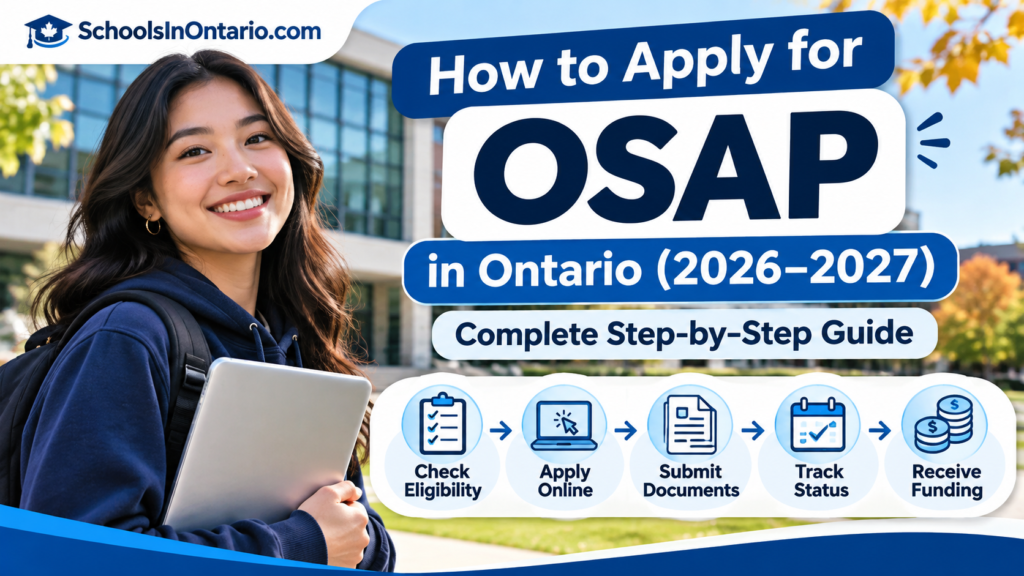
This comprehensive guide explains how to apply for OSAP in Ontario, from creating your account to checking your application status and receiving funding. We also explain common application mistakes, important deadlines, and what students should know about Ontario’s funding pause for private postsecondary institutions.
Table of Contents
Important OSAP Update for 2026–2027
Ontario has paused new OSAP applications for students attending private postsecondary institutions for the 2025–2026 and 2026–2027 academic years while a system-wide audit continues.
Students attending affected institutions cannot submit new applications for those years while the pause remains in effect. Eligible students outside the affected sector may continue using the normal application process.
Read: Ontario Government announces OSAP funding pause
What Is OSAP and How Does It Work?
OSAP stands for the Ontario Student Assistance Program. It is a government student financial assistance program designed to help eligible students pay for postsecondary education.
OSAP may help with education-related expenses such as tuition, textbooks, supplies, and living costs, depending on the student’s assessed financial need and eligibility.
Financial assistance can include:
- Grants: Financial assistance that generally does not need to be repaid, provided the student continues to meet applicable conditions.
- Loans: Borrowed money that must be repaid under the terms of the student loan agreement.
When students submit an OSAP application, they are generally assessed for both grants and loans. Full-time and part-time students who do not want the loan portion can normally decline it after approval.
Students should understand that the amount of grants and loans can vary depending on the academic year, program, institution, and individual circumstances.
Who Is Eligible to Apply for OSAP in Ontario?
Before starting an application, check whether you meet OSAP’s eligibility requirements.
Eligibility depends on several factors, including:
- Your Ontario residency status for OSAP purposes
- Your Canadian citizenship or eligible immigration status
- Whether your school and program are approved for OSAP
- Your course load and study period
- Your financial circumstances and assessed need
- Your academic progress and previous student loan history, where applicable
Canadian citizens, permanent residents, and protected persons may qualify if they meet the other applicable requirements. Simply attending a school in Ontario does not automatically make a student eligible for OSAP. International students studying in Canada solely under a study permit generally do not qualify under the standard OSAP eligibility rules.
Students who are uncertain about their eligibility should review the official OSAP application guidance or contact their institution’s financial aid office.
How Much OSAP Funding Could You Receive?
Before applying for OSAP, you may want to estimate how much financial assistance you could receive for your postsecondary education.
The Government of Ontario provides an official OSAP Aid Estimator that helps eligible students estimate their potential funding based on their educational costs and financial circumstances.
The estimator generally takes about 5–10 minutes to complete.
What Information Do You Need?
- Where you. would. study
- Your student/family situation
- The length or period of your study program
Use our OSAP calculator:
Estimate Your OSAP Funding for 2026–2027
Important: The calculator provides an estimate, not a guarantee of OSAP eligibility, approval or payment. Your actual funding may differ after your application is assessed.
Students should also verify that their institution and program are eligible for OSAP, particularly in light of Ontario’s funding pause affecting private postsecondary institutions.
What Do You Need Before Applying for OSAP?
Preparing the necessary information before starting can make the application process easier and reduce avoidable delays.
OSAP Application Preparation Checklist
- Your Social Insurance Number (SIN)
- Your legal name and personal contact information
- Your school and program details
- Your program start and end dates
- Your course load or study type
- Your income and tax information for the requested period
- Your parents’ or spouse’s financial information, if applicable
- Any supporting documents required for your circumstances
- Access to an email account for application notifications
Not every student will need the same documents. Your OSAP account will identify the forms and supporting information required for your individual application.
How to Apply for OSAP in Ontario: Step-by-Step Instructions
Step 1: Visit the Official OSAP Website
Begin by visiting the official Ontario Student Assistance Program website.
Choose the option to apply for OSAP and follow the instructions for the academic year in which you will be studying.
Always confirm that you are using an official Ontario government website before entering your personal or financial information.
Step 2: Create an OSAP Account or Sign In
If you are applying for OSAP for the first time, follow the account registration instructions. You will need to provide identifying information, including your Social Insurance Number, and establish your account credentials.
OSAP uses an OSAP Access Number (OAN) as part of its account system. Keep your account information secure. If you have applied for OSAP before, sign in to your existing account instead of creating another account.
Security reminder: Never share your SIN, password, OAN, or banking information in social media comments or public messages.
Step 3: Complete the OSAP Information Module If Required
First-time applicants for full-time and micro-credential OSAP may be required to complete an information module before beginning their application. The module introduces important topics, including grants, student loans, borrowing responsibilities, and repayment.
Follow the instructions displayed in your OSAP account. Students who have already completed the required module generally do not need to repeat it.
Step 4: Select the Correct Academic Year
Choose the academic year that matches your intended study period. For example, students beginning an eligible program during the 2026–2027 academic year should select the corresponding application.
Do not automatically select an academic year based only on the calendar date. Confirm the correct year using your school’s official program dates and the available OSAP application options.
Step 5: Choose Your Study Type
OSAP provides different application pathways for:
- Full-time postsecondary students
- Part-time postsecondary students
- Students enrolled in eligible micro-credential programs
Your application type depends on your program and course load. For standard full-time OSAP eligibility, students generally need to take at least 60% of a full course load. A reduced threshold may apply to students with qualifying disabilities under the applicable OSAP rules.
Students should confirm their course-load percentage with their institution rather than assuming that a particular number of courses automatically qualifies as full-time.
Step 6: Find Your School and Program
Next, search for your institution using its official name.
Confirm the following information:
- School name
- Campus location, where applicable
- Program name
- Program start and end dates
- Study period and course load
Be especially careful if your institution has multiple campuses or offers several programs with similar names. If you cannot find your institution or program, contact your school’s financial aid office before proceeding with incorrect information.
Step 7: Complete Your Personal Information
OSAP will ask questions about your identity, contact information, residency, and personal circumstances.
Depending on your situation, the application may ask about:
- Marital status
- Dependants
- Living arrangements
- Previous postsecondary education
- Other factors relevant to your eligibility
Answer each question accurately and follow the explanations provided within the application. Do not provide information based on what you think might increase your funding. Incorrect declarations may result in reassessment, delays, overpayments, or other consequences.
Step 8: Enter Your Financial Information
Your financial circumstances are an important part of the OSAP assessment. The application may request income and other financial information for a specified period.
Depending on your circumstances, you may also need information from your parents or spouse. Use the tax year and income definitions requested by OSAP. Do not assume that the application always uses the current calendar year’s income.
Ontario may verify income information through government records. If information cannot be verified, additional documentation may be required.
Step 9: Review Other Required Information
Depending on your application, OSAP may ask about financial contributions, other educational funding, and additional circumstances affecting your assessment. Complete each section using the instructions provided.
If you are unsure how to report an amount, seek clarification from your financial aid office before submitting incorrect information.
Step 10: Review and Submit Your Application
Before submitting, carefully review your answers.
Pay particular attention to:
- Your legal name and identification details
- The selected academic year
- Your institution and program
- Your study dates and course load
- Your income and family information
- Any declarations or agreements
If your application is incomplete, you can generally save your progress and return later. Once you are satisfied that the information is correct, submit the application.
After submission, OSAP may provide an estimate of your potential financial assistance.
Important: A funding estimate is not a guarantee that your application has been approved or that payment will be released.
Step 11: Check Your Required Documents
After submitting your application, sign in to your OSAP account and review the required documents section.
Depending on your circumstances, you may need to provide:
- Declaration and signature forms
- Proof of identity or status
- Income verification documents
- Family or marital-status documentation
- Other documents requested for your application
Submit documents using the instructions provided in your account or by your financial aid office.
Uploading a document does not necessarily mean that it has been reviewed and approved. Check its status afterward.
Step 12: Complete Your Student Financial Assistance Agreement
Some applicants must complete a Master Student Financial Assistance Agreement (MSFAA). The MSFAA sets out important terms and conditions associated with student financial assistance.
If you need to complete an MSFAA, the National Student Loans Service Centre (NSLSC) will provide instructions for completing the agreement online. Micro-credential students follow a different process and complete the applicable Micro-credential Student Loan Agreement for each application.
Follow the instructions for your specific application type.
Step 13: Track Your OSAP Application Status
You can check your application status through your OSAP account after submission.
Your account may show:
- Whether your application has been processed
- Outstanding documents or information
- Your funding assessment
- Information required from your school
- Estimated funding release dates
Ontario indicates that application processing can take approximately four to six weeks, depending on verification requirements and supporting documents. Apply early and check your account regularly so that you can respond promptly to any requests.
Step 14: Wait for Your School to Confirm Enrolment
Before funding can be released, your institution must confirm your enrolment. This step helps verify that you are attending the program and taking the course load associated with your application.
Your school may confirm enrolment shortly before your study period begins and again before a later instalment is released. If your enrolment has not been confirmed, your funding may not be released even if other application requirements have been completed.
Step 15: Receive Your OSAP Funding
After the required checks and enrolment confirmation are complete, eligible funding may be released.
For many full-time students, funding is normally issued in two instalments:
- The first near the beginning of the study period
- The second around the midpoint of the study period
The exact schedule depends on the program and application.
Some funding may be sent directly to your institution to cover tuition. Any remaining amount may be deposited into your designated bank account. Students in eligible micro-credential programs generally receive funding in one instalment under the applicable program rules.
Remember that approval and disbursement are different stages. If your account shows approved funding but no payment, review your outstanding requirements and contact your financial aid office if clarification is needed.
When Should You Apply for OSAP?
Students should apply as early as possible once the appropriate application becomes available and their school and program information is known. Ontario has different application deadlines depending on the study type and length of the program.
| Study Type | General Application Deadline |
|---|---|
| Full-time | 60 days before the end of the study period |
| Part-time, 21 weeks or longer | 60 days before the end of the study period |
| Part-time, 20 weeks or shorter | 40 days before the end of the study period |
| Micro-credential | By the end of the study period |
These are general application deadlines, not recommended dates to begin. Required supporting documents may have earlier or different submission deadlines.
For full-time and part-time applications, required documents generally must be submitted at least 40 days before the end of the study period. Micro-credential documentation follows a different deadline.
Always check the deadline displayed for your specific application and study period.
Common OSAP Application Mistakes to Avoid
1. Selecting the Wrong Academic Year
Confirm the year that matches your actual program dates rather than choosing based only on the current calendar year.
2. Entering Incorrect School or Program Information
Double-check your institution, campus, program, course load, and study dates.
3. Reporting Incorrect Income
Follow OSAP’s instructions for the required tax year and report income accurately.
4. Missing Supporting Documents
Submitting the online application is not always the final step. Check whether additional forms or verification are required.
5. Forgetting the Student Financial Assistance Agreement
If an agreement is required, complete it through the instructed process.
6. Waiting Until the Last Minute
Late applications can leave insufficient time to resolve document issues or complete verification before tuition is due.
7. Failing to Report Changes
Changes to your course load, study period, income, or other circumstances may require reassessment.
Contact your financial aid office if important information changes after you apply.
Frequently Asked Questions About Applying for OSAP
Can I apply for OSAP before receiving an admission offer?
You may be able to apply using your intended school and program information when the relevant application is available. Verify the details and update your application as required once your plans are confirmed.
Can I apply for OSAP at more than one school?
Ontario allows students to submit applications for multiple schools when they have not yet decided where to attend. Funding should ultimately proceed for the school and study period they actually attend.
Do I need to apply for OSAP every academic year?
Students generally submit a new application for each academic year in which they want assistance.
Can part-time students apply for OSAP?
Yes. Eligible part-time students can apply through the appropriate OSAP application pathway.
Can international students apply for OSAP?
Students in Canada solely on a study permit generally do not qualify under standard OSAP eligibility rules. Eligibility depends on residency and immigration status, along with other requirements.
How long does OSAP take to process?
Processing can take approximately four to six weeks, depending on verification and document requirements. Individual applications may take longer.
Does an OSAP estimate mean I have been approved?
No. An estimate is an indication of potential assistance and does not guarantee approval or disbursement.
Why has my OSAP funding not arrived?
Possible reasons include outstanding documents, incomplete verification, missing enrolment confirmation, or other application-specific requirements. Students at affected private institutions must also consider the current funding pause.
Can I receive OSAP grants without accepting a loan?
Eligible full-time and part-time students can generally decline the loan portion after approval while retaining any grants for which they qualify, subject to the applicable rules.
What happens if I drop a course after receiving OSAP?
Your funding may be reassessed if your course load changes. Depending on the circumstances, this can affect eligibility, funding amounts, or grant repayment obligations.
Can students at private colleges apply for OSAP in 2026–2027?
Ontario’s announced pause prevents new applications for students attending private postsecondary institutions for the 2025–2026 and 2026–2027 academic years while the pause remains in effect. Students should monitor the official announcement for changes.
Final Thoughts: Applying for OSAP Successfully
Applying for OSAP in Ontario involves several important steps, but understanding the process can make it easier to prepare.
Start by confirming your eligibility and checking your institution’s current status. Gather the required information, create or access your OSAP account, choose the correct application, and carefully complete the personal, school, and financial sections.
After submitting, remember to complete any required agreements, provide supporting documents, and monitor your application until the necessary verification and enrolment confirmation steps are complete.
Most importantly, do not confuse submitting an application, receiving a funding estimate, being approved, and receiving a payment. These are different stages.
For more practical guides to Ontario colleges, universities, admissions, and education costs, visit SchoolsInOntario.com.
Disclaimer: SchoolsInOntario.com is an independent educational information website and is not affiliated with the Government of Ontario or OSAP. This article provides general information and does not guarantee eligibility, approval, or funding. Application rules, deadlines, and government policies may change. Always confirm current requirements using official government guidance and your institution’s financial aid office.