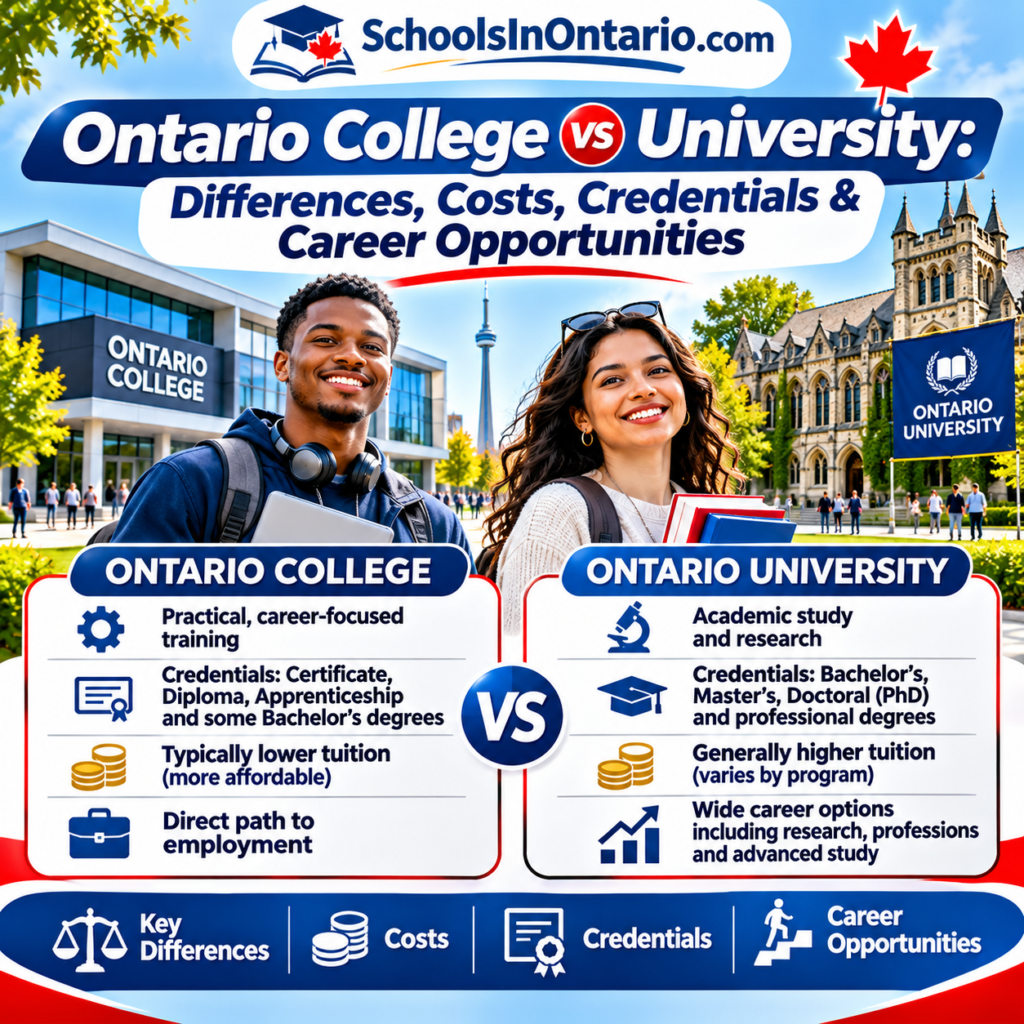
Should you choose a college or university in Ontario? Both can lead to valuable qualifications and rewarding careers, but they differ in their typical teaching approaches, credentials, costs and pathways. This guide helps domestic and international applicants compare their options before applying.
Quick Comparison: Ontario Colleges vs Universities
| Feature | Ontario College | Ontario University |
|---|---|---|
| Typical emphasis | Applied, practical and career-focused learning | Academic study, theory, research and professional preparation |
| Common credentials | Certificates, diplomas, advanced diplomas, graduate certificates and selected bachelor’s degrees | Bachelor’s, master’s and doctoral degrees, plus professional degrees and certificates |
| Typical program length | Often 1–3 years for certificates and diplomas; degree programs commonly 4 years | Bachelor’s degrees commonly 3–4 years; graduate programs vary |
| Hands-on opportunities | Labs, placements, applied projects and co-op in eligible programs | Labs, research, internships, clinical placements and co-op in eligible programs |
| Tuition | Often lower for comparable domestic diploma programs; varies widely | Often higher for domestic undergraduate programs; varies widely |
| Best fit | Students seeking a specific applied qualification or career pathway | Students seeking a degree, research opportunities or professions requiring university study |
Important: These are general patterns, not strict rules. Some colleges offer honours bachelor’s degrees, and many universities provide extensive hands-on training.
1. What Is an Ontario College?
Ontario’s publicly assisted colleges offer career-oriented programs in fields such as business, technology, health, hospitality, media and skilled trades.
Depending on the institution and program, students may earn a certificate, diploma, advanced diploma, graduate certificate or bachelor’s degree. Some programs include workplace placements, co-op or other experiential learning.
Colleges may be a good fit if you want a particular occupational qualification, an applied learning environment or a pathway that can later connect to further education.
Before applying, check whether a program has professional accreditation or meets the requirements of a regulated occupation.
2. What Is an Ontario University?
Ontario universities typically offer undergraduate and graduate degrees across arts, sciences, engineering, business, health and other disciplines.
Courses may combine lectures, seminars, laboratory work, research and professional or experiential learning.
Universities are often the standard route for careers requiring particular degrees or advanced academic study.
However, university education does not mean theory alone. Many programs offer co-op, internships, field placements, clinical education and applied capstone projects.
For example, explore our University of Toronto school profile to learn more about one of Ontario’s major universities.
3. Credentials: Certificate, Diploma or Degree?
One of the most important differences between colleges and universities is the range of credentials they commonly award.
- College certificate: Often a shorter, focused postsecondary program. Duration and entry requirements vary.
- College diploma: Commonly a two-year applied program.
- Advanced diploma: Commonly a three-year college program.
- Graduate certificate: Usually requires prior postsecondary education and focuses on specialized skills. It is not equivalent to a master’s degree.
- Bachelor’s degree: Offered by universities and authorized colleges, typically over three or four years depending on the program.
- Master’s degree: An advanced university qualification involving specialized coursework, research or professional preparation.
- Doctoral degree: An advanced research qualification generally offered by universities.
Do not choose a program based only on whether its credential is called a degree or diploma. Review its curriculum, credential recognition, professional licensing requirements and graduate outcomes.
4. College vs University Tuition and Total Costs
For many domestic students, a public college diploma has lower annual tuition than a university undergraduate degree.
However, this is not universal. Tuition depends on the institution, program, credential, student status and academic year.
International students may pay substantially higher tuition than domestic students at both colleges and universities.
What Costs Should Students Compare?
- Tuition and mandatory student fees
- Books, supplies, equipment and technology
- Housing and accommodation
- Food and transportation
- Health insurance and other living expenses
- Program duration and additional academic terms
- Placement or co-op expenses and potential earnings
When comparing offers, calculate the total cost of completing your program, not just tuition for one academic year.
Use each institution’s official tuition calculator or published fee schedule for your intended entry year.
Can Students Receive Financial Assistance?
Eligible Ontario residents may be able to access financial assistance through the Ontario Student Assistance Program (OSAP).
Financial assistance may also be available through institutional scholarships, bursaries and other awards.
Learn more through the official Ontario Student Assistance Program website.
5. Admission Requirements: College vs University
Ontario College Admission Requirements
College admission requirements vary depending on the institution and program.
Some programs require an Ontario Secondary School Diploma or equivalent and specific Grade 12 courses.
Competitive programs may require additional selection criteria, portfolios, interviews or assessments.
Ontario University Admission Requirements
University admission generally depends on secondary-school qualifications, required courses and academic performance.
Some programs also request supplemental applications, portfolios, interviews or other supporting materials.
Meeting the minimum admission requirements does not guarantee an offer, particularly for competitive programs.
How Do You Apply?
Students can begin researching participating Ontario college applications through Ontario Colleges.
For participating Ontario university applications, visit the Ontario Universities’ Application Centre (OUAC).
Always check the individual institution’s website for program-specific application instructions, requirements and deadlines.
6. Co-op, Internships and Practical Experience
Both Ontario colleges and universities may provide opportunities to gain practical work experience while studying.
College programs may feature practical laboratories, industry projects, clinical placements or co-op opportunities.
University programs may offer research projects, internships, clinical education, field placements or co-op programs.
Questions to Ask Before Choosing a Program
- Does the program offer co-op or internship opportunities?
- Are placements guaranteed or competitive?
- Are placements paid or unpaid?
- Does the institution help students find placements?
- Are additional fees or academic terms required?
- Will the experience help meet professional licensing requirements?
International students should also verify current immigration requirements and any work authorization needed for placements.
7. Career Opportunities: Which Pathway Is Better?
Neither college nor university automatically guarantees employment.
Career outcomes depend on the occupation, labour market, individual skills, program quality, work experience and professional licensing requirements.
Career Opportunities After College
College programs can provide pathways into many technical, administrative, creative and applied occupations.
Examples include fields such as information technology, business administration, skilled trades, health services, hospitality and digital media.
Career Opportunities After University
University degrees may be required for particular regulated professions, advanced academic study or research-intensive careers.
Graduates may pursue opportunities in engineering, education, research, business, science, technology, healthcare and other sectors, depending on their qualifications.
In many industries, employers recruit graduates from both colleges and universities.
Before choosing a program, compare actual job postings and professional licensing requirements.
You can also explore Ontario labour-market information to research employment trends and occupations.
8. Can You Transfer From an Ontario College to a University?
Yes. Some students transfer from Ontario colleges to universities through credit-transfer arrangements or formal academic pathways.
For example, a student who completes a college diploma may be eligible to apply for a related university degree program.
However, transfer credits are not automatic.
The number of credits accepted depends on the original program, receiving institution and applicable transfer agreement.
Students can explore available transfer pathways through ONTransfer.
Always confirm transfer eligibility directly with the receiving university before making an educational decision.
9. College vs University for International Students
International students considering Ontario should compare more than tuition and admission requirements.
They should also review the institution’s eligibility to host international students, study-permit requirements, program recognition and any relevant post-graduation work permit rules.
Not every program or institution offers the same immigration-related eligibility.
Students should verify the institution’s designated learning institution status and current rules through Immigration, Refugees and Citizenship Canada (IRCC).
Immigration policies may change, so students should rely on current official information rather than assuming that attending a college or university automatically provides eligibility for post-graduation work authorization.
10. How to Choose Between College and University
Before deciding, ask yourself these five questions:
- Career goals: What job or further qualification do I want after graduation?
- Credentials: What education and professional accreditation does my intended career require?
- Learning experience: Which program offers the courses, facilities and practical experience I need?
- Affordability: What is the total cost, including tuition, living expenses and program duration?
- Eligibility: Do I meet the admission requirements and any applicable immigration requirements?
Rather than comparing all colleges against all universities, shortlist at least three specific programs.
Compare their course outlines, graduate outcomes, student supports, tuition fees and admission requirements side by side.
Frequently Asked Questions
Is College Easier Than University in Ontario?
Not necessarily. College and university programs assess different skills. Academic difficulty varies by subject, credential and individual student strengths.
Can Ontario Colleges Award Bachelor’s Degrees?
Yes. Authorized Ontario colleges can offer bachelor’s degree programs. Students should verify the exact credential through the institution’s official website.
Is University Always More Expensive Than College?
No. University tuition is often higher than public college diploma tuition for domestic students, but actual costs depend on the specific program, student status, duration and living expenses.
Can College Graduates Attend University Later?
Yes. Some college graduates enter university degree programs or receive transfer credits through recognized pathways. Credit recognition must be confirmed by the receiving institution.
Which Is Better for International Students?
The better choice depends on academic goals, financial circumstances, career plans and current immigration eligibility rules.
International students should research the exact institution and program before applying.
Final Thoughts: College or University in Ontario?
Choosing between an Ontario college and university is an important educational decision, but neither pathway is automatically better.
Colleges often provide practical, career-oriented education, while universities generally emphasize academic study, research and advanced degrees.
Both can offer valuable qualifications, work-integrated learning and career opportunities.
The best choice depends on your personal goals, intended occupation, finances and preferred learning environment.
Explore Ontario Schools and Programs
SchoolsInOntario.com helps students, parents and education seekers research educational opportunities across Ontario.
Continue exploring our University of Toronto school profile and other school and program resources as our database expands.
Always verify tuition fees, admission requirements and program information with the relevant institution before applying.
Official Resources and Further Reading
- Government of Ontario: Colleges, Universities and Indigenous Institutes
- Ontario Colleges
- Ontario Universities’ Application Centre
- ONTransfer
- Ontario Student Assistance Program
- Immigration, Refugees and Citizenship Canada
Disclaimer: SchoolsInOntario.com is an independent educational information website and is not an official representative of Ontario educational institutions or government agencies. Admission requirements, tuition fees and policies are subject to change.